
Side-Entry Asphalt
Tank Mixers
Maintaining uniform temperature and product quality in asphalt cement, bitumen, and polymer-modified asphalt storage tanks since 1950.
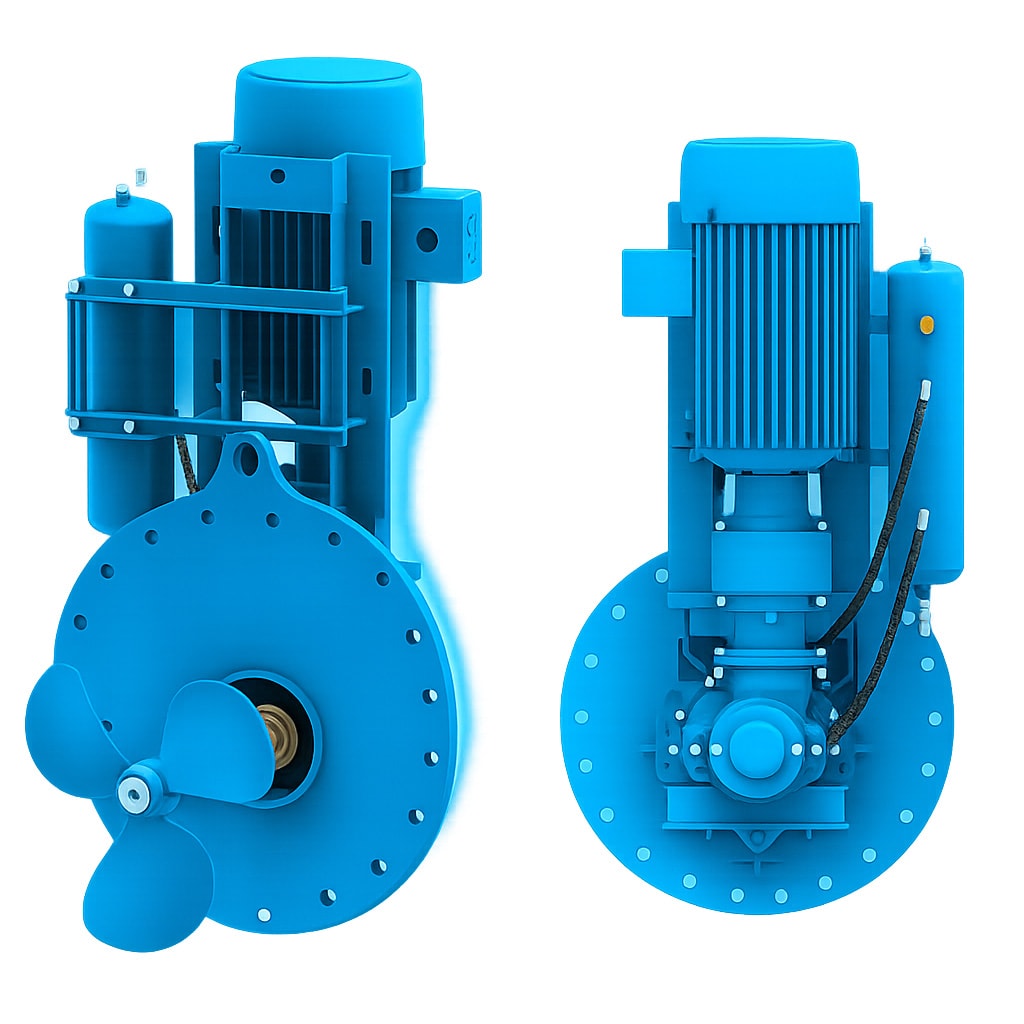
Why Asphalt Storage Tanks Need Mixing
Asphalt storage tanks are designed to keep asphalt cement, bitumen, and polymer-modified asphalt at elevated temperatures for extended periods. Without continuous circulation, temperature gradients develop, heavier components settle, and additives can separate — leading to inconsistent product quality and higher operating costs.
A properly engineered side-entry mixer continuously circulates the tank contents, maintaining a homogeneous product while improving heat transfer and reducing the frequency of tank cleanouts. Jensen Mixers have been used for decades in petroleum and asphalt applications where reliability and long service life are essential.
Benefits of Side-Entry Mixing
Uniform Temperature
Continuous circulation eliminates hot and cool layers, improving heat transfer across heating coils and reducing burner operating time. Better temperature control means lower fuel costs and more consistent product.
Product Homogeneity
Polymer modifiers, rubber additives, flux oils, and performance additives stay uniformly dispersed. Critical for PMA, roofing asphalt, emulsified asphalt feedstocks, and specialty paving grades.
Reduced Tank Cleaning
Jensen Mixers were originally developed to suspend BS&W in crude oil tanks. The same circulation principles minimize sludge, sediment, and heavy asphalt deposits — extending time between costly cleanouts.
Side-Entry vs. Top-Entry Mixers
For large asphalt storage tanks, side-entry mixers offer several structural and operational advantages over top-entry designs.
| Side Entry | Top Entry |
|---|---|
| Lower installation cost | Higher installation cost |
| No roof structural modifications | Roof reinforcement often required |
| Excellent full-tank circulation | Can create dead zones in large tanks |
| Easier field maintenance | Maintenance often requires roof access |
| Preferred for very large tanks | Better suited for smaller process vessels |
How Side-Entry Mixing Works
A side-entry mixer mounts directly through the tank shell. The propeller is positioned to create a large circulation loop — instead of merely stirring product near the mixer, properly engineered propeller thrust moves the entire tank volume.
This creates complete circulation, better heat transfer, uniform viscosity, and consistent asphalt quality throughout the tank. For very large tanks — typically over 60–80 feet in diameter — engineers sometimes install two or more side-entry mixers to optimize the circulation pattern.
Jensen's Phoenix Propeller is designed with an application-specific pitch-to-diameter ratio to maximize thrust and mixing efficiency. Each propeller is CFD-modeled and dynamically balanced to ISO 1940-G6.3 for smooth, reliable operation in continuous service.
Single vs. Dual Side-Entry Mixer Installations
Many tanks operate effectively with a single properly sized mixer. Very large tanks — typically over 60 ft in diameter — benefit from two mixers to achieve complete circulation coverage. Final mixer quantity should always be based on a complete engineering evaluation of tank geometry, product viscosity, heating coils, and required circulation — not tank diameter alone.
- Best for tanks up to ~50–60 ft diameter
- One large circulation loop
- Lower installation & operating cost
- Recommended for tanks over ~60 ft diameter
- Overlapping loops eliminate dead zones
- Redundancy during maintenance
| Feature | Single Mixer | Dual Mixers |
|---|---|---|
| Best Tank Size | Small to medium tanks | Large diameter tanks |
| Typical Tank Diameter | Up to ~50–60 ft (15–18 m)* | Over 60 ft (18 m)* |
| Circulation Pattern | One large circulation loop | Two overlapping loops for complete tank turnover |
| Temperature Uniformity | Excellent in properly sized tanks | Excellent, even in very large tanks |
| Heat Transfer | Improved over stagnant storage | Maximum heat transfer across the entire tank |
| Heating Coil Coverage | Good | Excellent — reduces cold zones around coil banks |
| Polymer Distribution | Very good | Superior for PMA and heavily modified asphalt |
| Dead Zones | Minimal when properly designed | Virtually eliminated |
| Tank Bottom Cleaning | Good solids suspension | Superior bottom sweeping action |
| Maintenance | One mixer to maintain | Redundancy allows one mixer to stay operational during maintenance |
| Installation Cost | Lower initial investment | Higher initial investment |
| Operating Cost | Lower power consumption | Higher total HP but often lower energy per unit volume in large tanks |
| Typical Applications | AC asphalt, fuel oil, small terminals | Large asphalt terminals, refineries, bitumen storage, PMA tanks |
* Final mixer quantity should always be based on a complete engineering evaluation of tank geometry, product viscosity, heating coils, and required circulation — not tank diameter alone.
Asphalt Engineering Calculators
Use our free online tools to estimate heat loss, look up viscosity at temperature, check mixer quantity, convert °F/°C, and calculate volume expansion — no login required.
When Is a Second Mixer Recommended?
A second side-entry mixer is often justified when one or more of the following conditions exist:
- Very large storage tanks
- High-viscosity asphalt or bitumen
- Polymer Modified Asphalt (PMA)
- Dense heating coil arrangements
- Internal baffles or structural columns
- Tight temperature uniformity requirements (±5°F or better)
- High product turnover rates
- Continuous loading and unloading operations
Benefits of Dual Mixers
- More uniform temperature throughout the tank
- Better heat transfer from heating coils
- Improved circulation behind coil bundles
- Reduced asphalt oxidation
- Better suspension of polymers and additives
- Less sludge accumulation
- Longer intervals between tank cleanouts
- Increased operational reliability through improved circulation coverage
Typical Applications
Common Asphalt Products Mixed
Key Design Considerations
No two tanks are exactly alike. Proper mixer sizing ensures complete circulation while minimizing power consumption. The most important design inputs are:
Features of Jensen Asphalt Mixers
The Jensen Series 500 is the recommended mixer for asphalt and bitumen service. Depending on the model and configuration, Jensen mixers offer:
Heavy-Duty Gear or Belt Drive
Series 500 gear-driven construction handles the demanding torque requirements of high-viscosity asphalt service.
High-Temperature Mechanical Seals
Seal options engineered for asphalt service temperatures up to 350°F, including double mechanical seal with thermo-siphon for the most demanding applications.
Phoenix Propeller
CFD-designed, pitch-adjusted, dynamically balanced propeller maximizes thrust and circulation efficiency in large asphalt storage tanks.
Petro-Block Leak Isolation
Proprietary leak isolation system provides secondary containment and simplifies maintenance without removing the mixer from service.
Cast Iron or 316SS Wetted Parts
Standard cast iron for asphalt and bitumen service; 316 stainless steel available for corrosive or specialty applications.
Rugged Industrial Construction
Built for decades of continuous service in terminals, refineries, and asphalt plants. Jensen Mixers have been installed on tanks up to approximately 1 million barrels.

Seal Options for Asphalt Service
A variety of sealing configurations allows flexibility in determining the best fit for the application. All seal options are designed for ease of field maintenance at elevated asphalt service temperatures.
Single Mechanical Seal
Standard configuration for most asphalt and bitumen storage applications. Suitable where a single seal provides adequate containment at operating temperatures.
Double Mechanical Seal with Thermo-Siphon System
Recommended for PMATwo-seal arrangement with a thermo-siphon barrier fluid system. Recommended for polymer-modified asphalt, high-temperature service, and applications requiring secondary containment. The thermo-siphon system circulates barrier fluid passively — no pump required.
Stuffing Box
Compression packing arrangement for applications where mechanical seals are not preferred. Field-adjustable and serviceable without removing the mixer from the tank.
Seal selection depends on asphalt grade, operating temperature, and secondary containment requirements. Contact our team to discuss the right configuration for your application.
Frequently Asked Questions
Why mix asphalt in storage tanks?
To maintain temperature uniformity, prevent settling, reduce oxidation, improve heat transfer, and ensure consistent product quality at the point of use.
Can one mixer handle a large asphalt tank?
Many tanks can be effectively mixed with a single properly sized unit. Very large tanks — typically over 60–80 feet in diameter — may require two or more mixers to achieve complete circulation.
Will mixing damage polymer modified asphalt?
No. Properly designed low-speed side-entry mixers circulate the product while minimizing unnecessary shear. The Series 500 operates at 430 RPM, which is well within the acceptable range for PMA.
Does mixing reduce fuel costs?
Yes. Better circulation improves heat transfer efficiency across heating coils, reducing burner operating time and lowering energy consumption.
How long do Jensen side-entry mixers last?
Jensen Mixers are built for decades of continuous industrial service. With proper maintenance per the IOM manual, service life of 20+ years is common in asphalt and petroleum applications.
What is the typical storage temperature for asphalt?
Most asphalt grades are stored at 300–350°F (150–175°C). The Jensen Series 500 is specifically engineered for high-temperature service with appropriate seal and material options.
Ready to Size a Mixer for Your Asphalt Tank?
Provide your tank diameter, height, asphalt type, storage temperature, and mixing objective — our team will recommend the right Series 500 configuration for your application.
Jensen Series 500
Gear-driven special application mixer. Up to 40 HP. Cast iron or 316SS wetted parts. Multiple seal configurations for high-temperature asphalt service.
View Series 500 SpecsRequest a QuoteSeries 500 Quick Specs
Typical Tank Capacities
Large tanks may utilize multiple mixers to optimize circulation patterns.